
A7 · Clinical conditions
Bone augmentation before a dental implant: when it's needed
Bone augmentation rebuilds ridge volume when there is not enough structure to seat an implant safely. This article explains when grafting is necessary, compares the four material families — autograft, allograft, xenograft, alloplast — across healing time and indication, walks through block, particulate, and guided bone regeneration formats, and shows why alveolar ridge preservation at extraction cuts later resorption by roughly half.
- Published
- 2026-05-20
- Reading time
- 9 minutes
- Author
- Prof. Robert Ćelić
- Section
- Clinical conditions
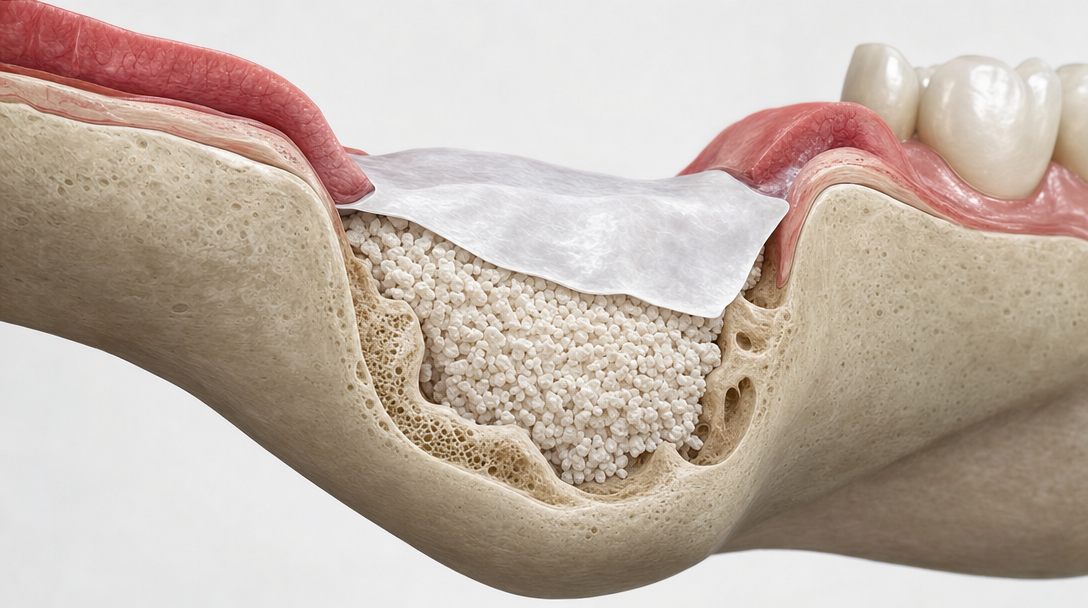
At our specialist clinic for dental implants in Zagreb, the third most common preparatory step we discuss with Swedish patients is bone augmentation — what most patients have heard about as "bone graft" and what most are quietly worried about because it sounds invasive. The honest version: there are four graft material families, the differences between them matter, and modern bone augmentation is a smaller deal than the word "graft" implies.
What is bone augmentation, and when is it necessary?
Bone augmentation — benuppbyggnad in Swedish — is the surgical addition of bone or bone-substitute material to a deficient alveolar ridge. The goal is to give an implant enough bone volume to anchor in.
A quick note on terminology. Swedish dental practice uses benuppbyggnad for any graft type. Bentransplantation is technically a subset: it specifically means transplanting bone from another site (autologous bone). When the graft is allograft, xenograft, or synthetic, "transplantation" is the wrong word. We use benuppbyggnad consistently because it covers all four material families correctly.
When is it actually needed? The honest answer is: in roughly a quarter of implant cases, depending on what happened after the original tooth was lost. The main triggers are:
- · Tooth loss without immediate post-extraction socket preservation — ridge width can lose roughly a third to half of its width in the first year (Tan et al. 2012), with most of the loss in the first few months, and the loss can continue over the following years.
- · Long-term edentulism — years without teeth in a region accelerates the loss.
- · Trauma or congenital absence.
- · A failed previous implant requiring re-grafting.
- · Sinus floor proximity in the upper posterior maxilla — covered separately in our sinus lift before a dental implant article.
A prevention angle worth knowing. If the tooth has not yet been extracted but is condemned, an immediate post-extraction graft can be placed in the socket. This is called alveolar ridge preservation, or ARP. It reduces ridge dimensional loss in the first few months by roughly half (Avila-Ortiz et al. 2014). ARP does not fully prevent resorption; it mitigates it. For patients still considering extraction timing, raising the option early can avoid a larger augmentation later.
The clinical reality is that bone augmentation has become routine over the last twenty years and is regarded as predictable across techniques. The question is no longer whether augmentation works. It is which technique and material are right for your specific defect.
The four graft material families — and what each is good for
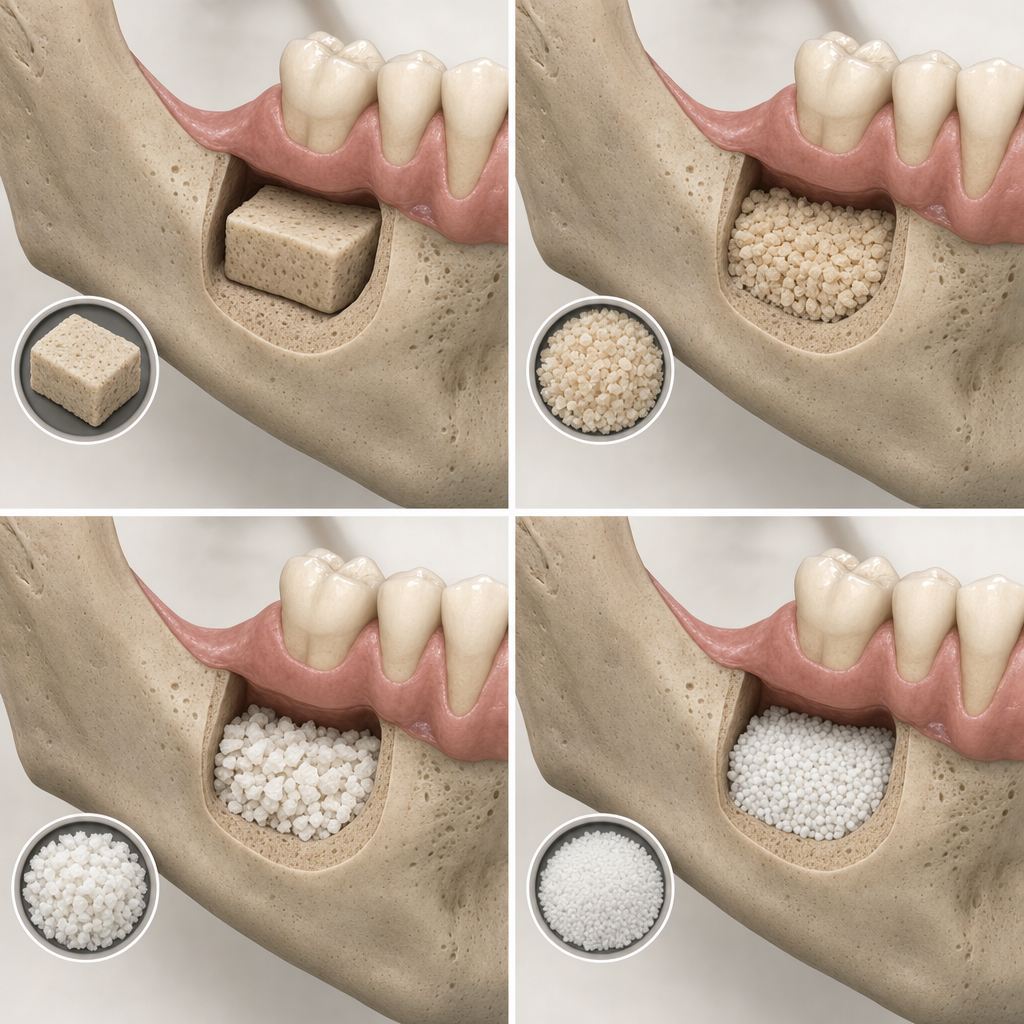
1. Autologous bone — your own bone, harvested from another site.
- · Source: usually the mandibular ramus or chin (intraoral); rarely the iliac crest for very large reconstructions
- · Pros: gold standard for bone biology; contains living osteogenic cells; fastest integration (3–4 months for small-to-moderate intraoral grafts; 4–6 months for larger reconstructions)
- · Cons: a second surgical site means donor-site morbidity; limited volume available; longer operative time
- · Best for: small to moderate vertical augmentations with healthy donor sites elsewhere
2. Allograft — processed human donor bone.
- · Source: tissue banks under FDA / EU regulation
- · Pros: no donor-site surgery; unlimited supply; well-characterised integration
- · Cons: slower integration (4–6 months); a theoretical (but extremely low) disease-transmission risk; some patients prefer not to use human donor tissue for personal reasons
- · Best for: moderate-to-large defects where avoiding a second surgical site matters
3. Xenograft — animal-derived bone, almost always bovine. Bio-Oss is the canonical example.
- · Source: bovine bone, fully de-proteinized and sterilized
- · Pros: unlimited supply; excellent long-term volume stability (the material resorbs very slowly, acting as a long-term scaffold); over 30 years of clinical data
- · Cons: slower biological integration (6–9 months); some patients prefer not to use animal-derived material for dietary or religious reasons
- · Best for: sinus lifts, large augmentations where long-term volume preservation matters most
4. Synthetic — lab-manufactured (β-TCP, hydroxyapatite, biphasic calcium phosphate, bioactive glass).
- · Source: biocompatible ceramic and glass materials manufactured to defined specifications
- · Pros: no biological-source concerns; predictable behaviour; the lowest cost of the four
- · Cons: osteoconductive only (a passive scaffold), not osteoinductive; less long-term clinical data than xenograft
- · Integration nuance: β-TCP-based materials typically ready at 3–6 months; HA-rich or dense ceramic synthetics often require 6–9 months and leave long-term remnants
- · Best for: smaller defects, or patients who prefer not to use human or animal grafts
An emerging fifth option worth mentioning. Tooth-derived autograft uses the patient's own extracted teeth — cleaned, demineralized, and chairside-processed — as graft material. Limited but encouraging clinical evidence suggests new bone formation comparable to xenograft and allograft at 4–6 months, with no donor-site morbidity. Not yet standard of care, but a real option in selected centres for patients who happen to be extracting a tooth at the same visit.
The right choice for your specific case depends on the defect geometry, the volume needed, your overall health, and your personal preferences about graft source. We make that decision at consultation based on CBCT imaging and clinical exam — not from a brochure. For broader context on the implant pathway, see our dental implants in Croatia overview.
How the procedure works — block grafts, particulate, and GBR
There are three real surgical formats. Each fits a different defect type.
Block graft.
- · A solid piece of bone (usually autologous, harvested from the ramus or chin) is fixed to the host site with mini-screws
- · Indicated for large three-dimensional defects where particulate would not hold shape
- · 4–6 months of integration before implant placement
- · Higher technique demand, longer recovery
- · Implant survival in block-augmented sites is high and broadly comparable to native bone (Aghaloo & Moy 2007)
Particulate graft.
- · Granular material (allograft, xenograft, synthetic, or a mix with autologous chips) is packed into the defect
- · Almost always combined with a barrier membrane — see GBR below
- · Indicated for moderate defects, sinus lifts, and socket preservation
- · 4–9 months of integration depending on material
Guided bone regeneration (GBR) — the modern standard for most augmentations.
GBR adds a barrier membrane over the particulate graft. The membrane keeps soft tissue out of the graft space, so only bone-forming cells reach the defect. The contemporary consensus is:
- · For horizontal defects — a resorbable collagen membrane with particulate graft is the standard. Fewer complications than non-resorbable options. Implant survival in horizontally augmented ridges is high and broadly comparable to native bone.
- · For vertical or complex defects — non-resorbable titanium-reinforced PTFE or, increasingly, a CAD/CAM custom titanium mesh holds space for larger vertical gains (typically 4–7 mm). Implant survival remains high; the trade-off is a higher rate of mesh exposure, usually manageable without losing the entire graft.
- · For socket preservation specifically — small-pore-size dPTFE is favoured in some protocols because it resists bacterial penetration and can be left partially exposed.
A real modern trend worth knowing. The contemporary direction is to prefer horizontal GBR and ARP over large vertical onlay grafts whenever the prosthetic plan permits. Narrow-diameter implants in selected cases of very narrow ridges can avoid extensive horizontal augmentation entirely. Less invasive, faster recovery, fewer complications. Not always possible, but always worth checking on the CBCT before committing to a major graft.
Honest framing per voice guide §5:
There is no universal best technique. The right approach depends on defect size, defect geometry, your overall health, and the implant timeline. A surgeon who recommends the same approach for every patient should be a warning sign.
Recovery, integration time, and what affects success
Recovery from a well-performed augmentation is similar to recovery from a wisdom tooth extraction. Most Swedish patients we treat describe days three to four as the worst, with significant improvement by day seven.
Typical timeline:
- · Day 0: procedure under local anaesthesia, with optional sedation. Patient returns to hotel or home the same day.
- · Days 1–7: mild-to-moderate swelling, soft diet, antibiotic and anti-inflammatory regimen. Avoid pressure on the surgical site.
- · Weeks 2–4: sutures dissolve or are removed at the week 1–2 visit. Most discomfort resolves.
- · Months 3–9: the graft integrates. A CBCT at 4–9 months (timing depends on material and volume) confirms readiness for implant placement.
Patient-side factors that affect success. Smoking is the single biggest modifiable risk — smokers face roughly double the implant failure risk of non-smokers (Chrcanovic et al. 2015). For grafts specifically, smoking raises the risk of complications (membrane exposure, infection, partial graft loss). The cessation window we recommend is 4–8 weeks pre-op and continued abstinence post-op. This is expert consensus extrapolated from periodontal and general surgical literature, but the direction of the evidence is unambiguous.
Diabetes control matters too. Well-controlled diabetes (more on healing in our healing process explainer) is not an exclusion. Poorly controlled diabetes meaningfully impairs graft integration. Oral hygiene at the surgical site and post-op medication compliance round out the patient-side picture.
Clinician-side factors. Atraumatic flap design and tension-free primary closure are the technique fundamentals. Graft material must match the defect. Membrane perforation during placement leads to graft exposure and resorption.
Material-side factors. Integration speed varies by material as covered above. Long-term volume stability is best with xenograft, moderate with synthetic and allograft, and excellent (but resorption-prone) with autograft.
Complication-profile transparency. This matters for informed consent. Horizontal GBR and ARP carry low complication rates, mostly minor (temporary swelling, slight wound dehiscence). Vertical GBR and block grafts carry a meaningfully higher rate of early complications — typically membrane exposure or partial graft loss. The complications are usually manageable without losing the augmentation, but you should know this before signing consent.
A patient-reassurance point worth stating directly. Implants placed in properly augmented bone show similar long-term marginal bone loss to implants in native bone. Grafted bone is not inherently inferior. It is bone that needed a head start.
Honest framing per voice guide §5:
Bone augmentation has become routine in modern implant dentistry — but only because the technique, material, and patient selection are correct. A "we'll figure it out when you get here" approach is a warning sign, not a flexible plan.
Bone augmentation is one of those procedures where surgeon experience, technique selection, and material choice compound visibly in long-term outcomes, and the difference between routine and exceptional clinical practice is real. If you have been told you need a graft and want a CBCT-based second opinion from a named specialist with a verifiable EDA-Expert credential, Prof. Robert Ćelić, European Expert in Implantology reviews cases personally in a free 30-minute consultation. No deposit, no commitment.
References
Sources cited in this article.
- Tan WL, Wong TL, Wong MC, Lang NP (2012) — A systematic review of post-extractional alveolar hard and soft tissue dimensional changes in humans. Clin Oral Implants Res 2012;23(Suppl 5):1–21. PMID 22211303. Cited in the text.
- Avila-Ortiz G, Elangovan S, Kramer KW, Blanchette D (2014) — Effect of alveolar ridge preservation after tooth extraction: a systematic review and meta-analysis. J Dent Res 2014;93(10):950–958. PMID 24966231. Cited in the text.
- Chrcanovic BR, Albrektsson T, Wennerberg A (2015) — Smoking and dental implants: A systematic review and meta-analysis. J Dent 2015;43(5):487–498. PMID 25778741. Cited in the text.
- Aghaloo TL, Moy PK (2007) — Which hard tissue augmentation techniques are the most successful in furnishing bony support for implant placement? Int J Oral Maxillofac Implants 2007;22(Suppl):49–70. PMID 18437791. Cited in the text.
Read next
Three pages worth your time.
The Pezo–Ćelić Protocol
Dental implants in Croatia — 20-year written guarantee
The full offer stack, dual guarantees, and surgeon-team accountability detailed.
Named credentials
Prof. Ćelić, European Expert in Implantology
Full Professor at University of Zagreb. BDIZ EDI certified. 916+ citations.
Related article
Osseointegration — how an implant fuses with the jawbone
What grafted bone has to achieve next: locking onto the implant surface through the three phases of osseointegration.
Frequently asked questions
What is bone augmentation and why do some implant patients need it?
What are the four graft material families and how do they differ?
How much bone is lost after a tooth extraction?
How long does bone augmentation take to heal before an implant can be placed?
Does smoking affect the success of bone augmentation?
Do implants in augmented bone last as long as implants in natural bone?
Ready when you are
Want a CBCT-based assessment from a named specialist?
A free 30-minute consultation. Send us your X-rays or current treatment plan. We will review it, give you our honest assessment, and confirm whether you are a candidate. If we do not think we are the right fit for your case, we will say so.
No deposit. No commitment.