
A8 · Recovery and protocols
Dental implant healing time: a week-by-week recovery guide
A week-by-week reference for what implant recovery actually looks like, written for the Swedish patient flying home to heal after surgery in Zagreb. This article maps the soft-diet timeline, the chlorhexidine and saline hygiene protocol, the days 2-3 swelling peak, and the specific warning signs — fever above 38°C, worsening swelling after day 4, persistent bleeding, a mobile implant — that warrant calling the clinic.
- Published
- 2026-05-20
- Reading time
- 7 minutes
- Author
- Ars Salutaris clinical team
- Section
- Recovery and protocols
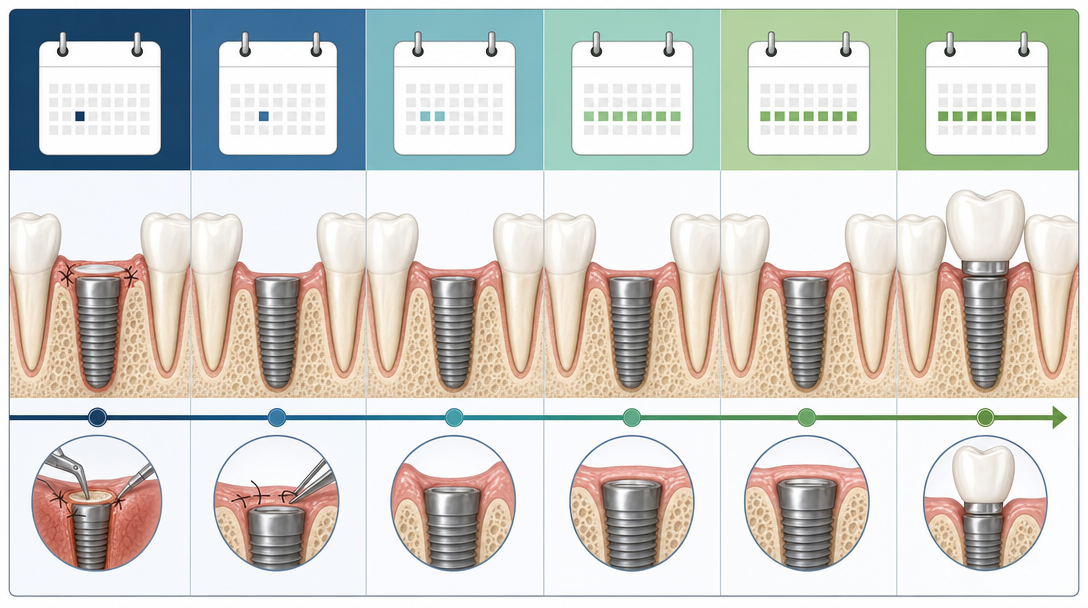
At our specialist clinic for dental implants in Zagreb, the question Swedish patients ask most often after the surgery is some version of: what should I expect once I'm back home? You will be hundreds of kilometres from the clinic, and you want a clear written reference so you know what is normal and what warrants a call. This is that reference.
What happens in the first 24–72 hours
The most-asked window. Most of the visible recovery happens here.
Day 0 — surgery day.
- · Local anaesthesia wears off 2–6 hours after surgery; some discomfort begins
- · Light bleeding for 12–24 hours (saliva tinged pink) is normal
- · Numbness in the lip or chin (lower-jaw cases) for 4–8 hours is normal
- · The first dose of antibiotic and anti-inflammatory is taken with food before you leave the clinic
- · Cold compress (ice on the cheek, 20 minutes on / 20 minutes off) for the first 12 hours reduces swelling
Day 1.
- · Swelling typically peaks at day 2–3, not day 1 — so a day-1 increase is expected, not a sign of trouble
- · Soft cold diet: yoghurt, smoothies, mashed potato, lukewarm soup. Nothing hot.
- · Continue the antibiotic and anti-inflammatory on schedule
- · No vigorous mouth rinsing. Gentle saline rinses can start from day 2.
- · No straws (suction can dislodge clots)
- · No alcohol, no smoking
Day 2–3.
- · Swelling peak. Your face may look noticeably puffy. This is normal.
- · Bruising over the cheek is possible. It usually turns yellow-green by day 5.
- · Discomfort should be manageable with the prescribed anti-inflammatory
- · Sleep with your head slightly elevated for the first three nights
For Sweden-wide patient guidance on the basics of artificial teeth and implants, 1177.se patient information on artificial teeth is the institutional reference. It does not replace your written aftercare protocol from us, but it is a useful cross-reference.
Week 1 to week 2 — what is normal, what is not
This is the phase where Swedish patients are home, far from the clinic. The single most useful thing to know: the trajectory matters more than any single symptom. Things should be getting better day by day, not worse.
Normal at week 1.
- · Swelling resolving, jaw stiffness improving
- · Mild discomfort, manageable without strong analgesia
- · Suture removal at the week 1–2 visit (sometimes the sutures are self-dissolving)
- · Soft diet still recommended
- · Brushing of non-surgical teeth normal. The surgical site is cleaned with saline and special gauze per the clinic protocol.
Normal at week 2.
- · Swelling fully resolved
- · Bruising faded
- · Eating soft foods comfortably
- · No bleeding
- · The surgical site looks pink and intact
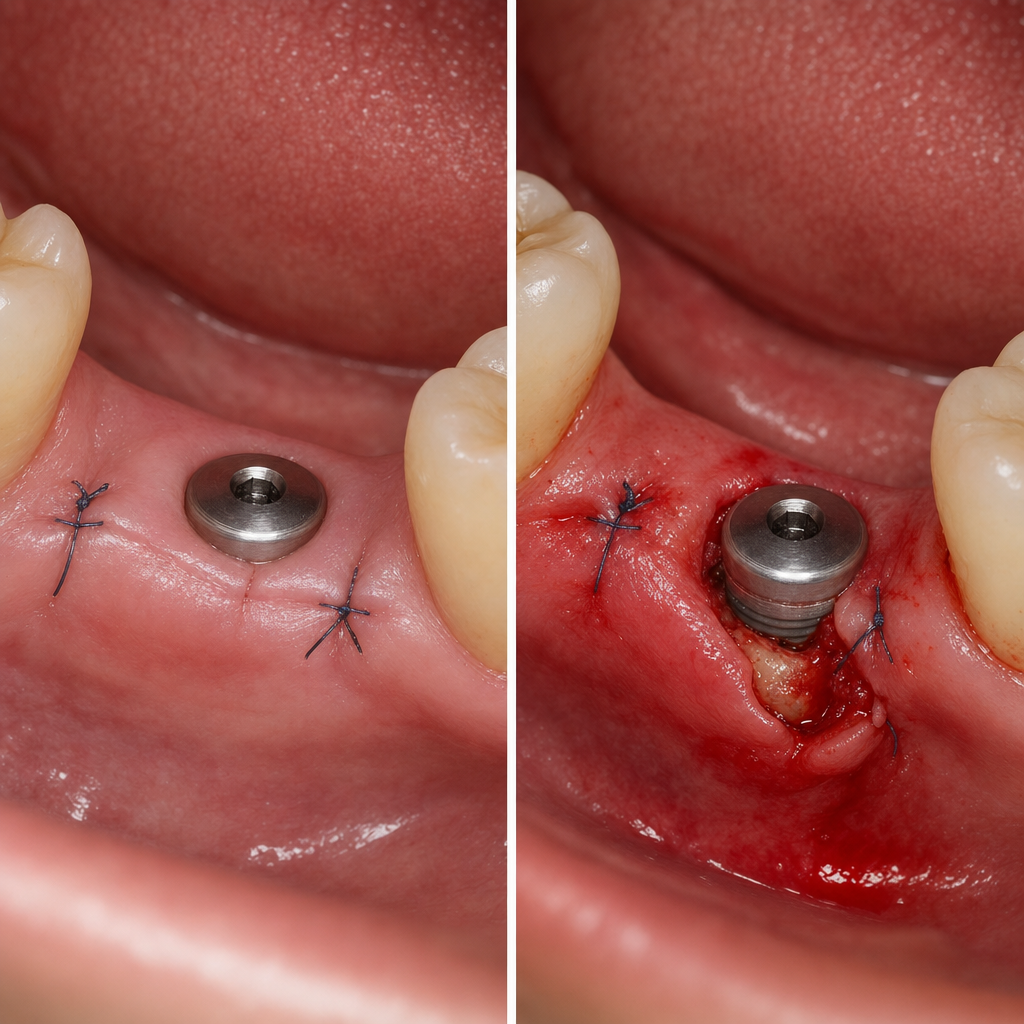
When to call the clinic — warning signs.
- · Increasing pain after day 3 (instead of decreasing) — possible infection
- · Persistent or fresh bleeding beyond 24 hours
- · Fever above 38°C at any point
- · Suture-line opening with visible bone or implant
- · Foul taste or discharge from the surgical site
- · Numbness persisting beyond 24 hours (lower jaw)
If any of these appear, contact us first. In our experience, photographs over WhatsApp and a short video consultation resolve most post-op queries without requiring you to travel. Some warning signs suggest something more serious in the longer term — bone loss around the implant, recurrent gum inflammation months later. For those, see our separate guide on peri-implantitis and how we prevent it.
How we handle remote patients. If an in-person assessment is needed urgently, we help you arrange care in Sweden — typically with your own dentist or a clinic near you — and send the full treatment record within hours. We do not abandon the patient at the airport. The remote-aftercare protocol is part of every implant treatment plan, not an afterthought.
Weeks 3 to 12 — the silent integration phase
This is where osseointegration happens — the biological process explained in detail in our how osseointegration actually works article. From the outside the implant looks settled; underneath, bone-forming cells (osteoblasts) deposit new bone directly onto the implant surface week by week.
Weeks 3–4. Initial bone-implant bridges form. The surgical site looks fully healed.
Weeks 5–8. Bone density around the implant increases. The implant transitions from primary stability (mechanical fixation, like a screw in wood) to secondary stability (biological, where bone grows directly onto the titanium). Modern surface-modified implants — SLActive and similar hydrophilic surfaces — reach biological integration faster. Under good conditions, integration is essentially complete by week 6 in the lower jaw and week 8 in the upper jaw. The older "12-week minimum" framing comes from Brånemark-era machined-surface implants and still applies to compromised cases.
Weeks 9–12. Bone remodelling matures and consolidates. By week 12, the implant is fully osseointegrated in most cases. In smokers (who face roughly double the failure risk — see our osseointegration explainer for the precise effect sizes), poorly controlled diabetics, and patients with bone augmentation, integration may extend to 4–9 months depending on graft material and volume.
What you should do during this phase:
- · Resume normal oral hygiene. Gentle brushing of the surgical area can start at week 2.
- · Resume normal exercise from week 2–3. No contact sports until cleared at the 8-week check.
- · Maintain a soft-to-normal diet. Avoid hard nuts, hard candy, and ice chewing for now.
- · Avoid smoking. It extends integration by weeks and elevates failure risk.
- · Attend the 8-week check-up — in person at the clinic if you happen to be in the area, or with your own dentist in Sweden if not (we send the treatment record on request).
What you should avoid:
- · Loading the implant prematurely (chewing hard food directly on the implant site)
- · Aggressive flossing around the implant — a special floss technique is recommended and we demonstrate it at the suture-removal visit
- · Whitening agents at the surgical site
When an implant is ready for functional load is judged case by case — based on implant stability, bone quality, and healing progress — and confirmed clinically, usually with a CBCT scan, before any load is applied.
Months 3 to 6 — when the implant is ready for the permanent restoration
This is the transition from healed implant to functional tooth replacement.
Months 3–4.
- · Most lower-jaw implants are ready for the permanent crown by month 3 (good bone, no augmentation)
- · Upper-jaw implants typically need 4–6 months due to softer bone in the maxilla
- · Implants with bone augmentation: 6–9 months depending on the graft material and volume — see our bone augmentation guide for the per-material timelines
- · A CBCT scan confirms integration before any prosthetic load is applied
Months 4–6.
- · The permanent abutment is placed — usually a single visit, often without anaesthesia
- · Impressions are taken. At Ars Salutaris these are digital scans, sent immediately to our in-house Naturaldent CAD/CAM lab.
- · The final crown, bridge, or All-on-4 prosthesis is fitted within 5–7 days
For the full treatment pathway from consultation to final restoration, see dental implants in Croatia.
After the permanent restoration.
- · Annual check-up recommended — in person at Ars Salutaris, or with your own dentist in Sweden (we provide the records they need on request)
- · Daily oral hygiene normal. Special interdental brushes are recommended for under bridges.
- · 20-year written manufacturer guarantee on the implant body (ICX by Medentis Medical GmbH) — verified by the manufacturer; full guarantee terms supplied at consultation
- · 3-year prosthetic warranty on crowns and bridges (manufacturer-backed, materials only)
Honest framing.
Implant integration is a process, not an event. Plan for 4–6 months from surgery to the permanent restoration — sometimes longer if you needed bone augmentation. The implant itself, once integrated, is designed to last decades.
Implant recovery is one of those journeys where the most important phase is the one the patient sees the least — the silent integration weeks. The clinics that handle dental-tourism patients well are the ones that make the remote-aftercare phase feel structured rather than abandoned. We provide every Swedish patient with a written week-by-week schedule, WhatsApp access to the clinical team, and coordination with a Swedish dental partner if in-person assessment is needed. If you are considering implant treatment and want to understand the full aftercare structure, book a free consultation — no deposit, no commitment.
References
Sources referenced.
- 1177.se — Konstgjorda tänder. Sweden's national health information service, patient-facing lay reference. External link in H2.1.
- Brånemark P-I, Adell R, Breine U, et al. (1969) — Intra-osseous anchorage of dental prostheses. I. Experimental studies. Scand J Plast Reconstr Surg 1969;3(2):81–100. PMID 4924041. Albrektsson T, Brånemark P-I, Hansson H-A, Lindström J (1981) — Osseointegrated titanium implants. Acta Orthop Scand 1981;52(2):155–170. PMID 7246093. Classic, conservative healing timelines.
- Modern integration timing (4–6 wk mandible / 6–8 wk maxilla under SLActive-type surfaces) reflects current clinical practice with surface-modified implants and is summarised in our osseointegration article.
- Chrcanovic BR, Albrektsson T, Wennerberg A (2015) — Smoking and dental implants: A systematic review and meta-analysis. J Dent 2015;43(5):487–498. PMID 25778741. Smoking roughly doubles the risk of implant failure; cited in the text.
- Bone augmentation integration timing (4–9 months depending on graft material and volume): clinical practice, see also post #3.
Read next
Three pages worth your time.
The Pezo–Ćelić Protocol
Dental implants in Croatia — 20-year written guarantee
The full offer stack, dual guarantees, and surgeon-team accountability detailed.
Named credentials
Prof. Ćelić, European Expert in Implantology
Full Professor at University of Zagreb. BDIZ EDI certified. 916+ citations.
Related article
Osseointegration — how an implant fuses with the jawbone
The biology underneath the week-by-week timeline — why early healing is mechanical and real integration takes months.
Frequently asked questions
What should I expect in the first 24 to 72 hours after implant surgery?
How long is the swelling and bruising phase after a dental implant?
When should I call the clinic — what are the warning signs?
When is a dental implant fully integrated with the bone?
When can the permanent crown or bridge be placed after implant surgery?
Can I exercise and eat normally during implant healing?
Ready when you are
Want a CBCT-based assessment from a named specialist?
A free 30-minute consultation. Send us your X-rays or current treatment plan. We will review it, give you our honest assessment, and confirm whether you are a candidate. If we do not think we are the right fit for your case, we will say so.
No deposit. No commitment.